Restaurants and kitchens
A restaurant floor has two different problems. In the kitchen it is grease: cooking fat settles on the floor, mixes with grit and gets pushed into anti-slip texture and grout until the floor is dark and slippery. Front of house it is traffic: walkways from the door, to the bar and to the toilets go grey first.
- Degrease first. An alkaline degreaser with enough dwell time to break the fat down before the machine goes over it.
- Brushes for anti-slip tiles. Kitchen tiles are usually textured. A brush reaches into the texture where a flat pad can’t.
- Extraction, not flooding. The greasy solution is vacuumed up, not pushed into drains or under equipment.
- Around equipment. Fixed units are cleaned around; tell us what can be moved.
Busy kitchens and heavily used floors are usually in the heavy-use band (€20/m²). DIY tips for between cleans: how to deep clean a tile floor.
Hotels and guest accommodation
In a hotel the challenge is keeping the building working. Lobbies, corridors, stairs, breakfast rooms and guest rooms all see different traffic.
- In sections. Corridors and public areas done in sections so there is always a way through.
- Rooms in blocks. Guest rooms done in blocks between departures and arrivals, agreed with housekeeping.
- Quiet hours. We agree working times for areas near occupied rooms.
- Entrances first. The areas that guests see first and that carry the most sand from outside.
Property managers and multiple properties
If you look after holiday villas or apartments for owners, floors are one of the first things guests notice and one of the hardest to keep right with weekly changeover cleaning.
- One quote, several properties. Send photos and m² per property; each is priced at the same per-m² rates.
- Between bookings. We fit the deep clean into gaps in the calendar, ideally before the season or after a busy run.
- Key-holder friendly. No need for the owner to be there.
- Repeat work. Floors that are deep cleaned regularly are faster to clean next time and stay in the base price band.
Offices and shops
Large-format porcelain in offices, clinics and shops wears evenly but looks tired in the walkways, around desks and at the entrance. These floors are usually in the base band and are well suited to a scheduled clean every season.

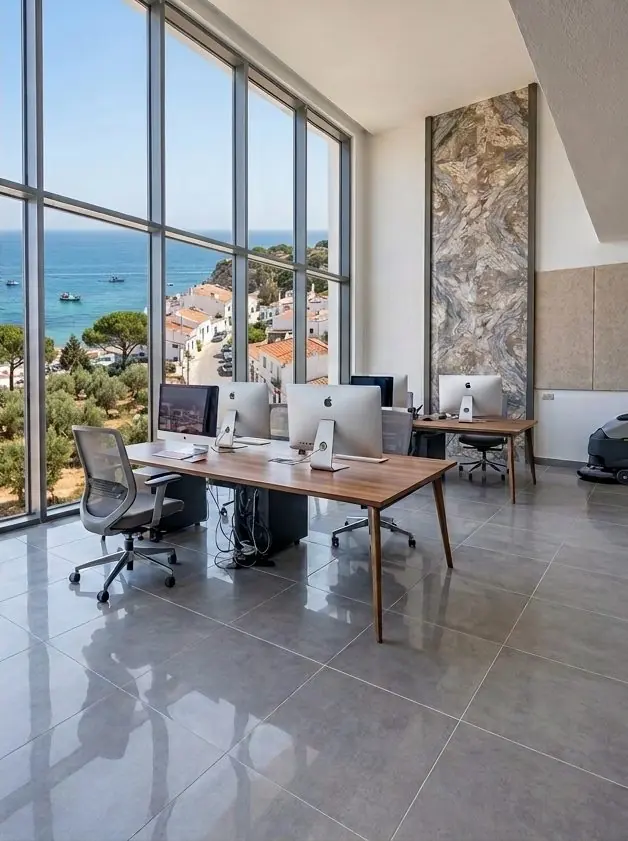
Low-disruption scheduling
- Photos and floor plan. Photos of each area plus approximate m², or a simple sketch.
- A written plan. Which areas, in which order, on which days, and what needs to be closed off and for how long.
- Work around you. Closed days, quiet hours, or in sections while you stay open.
- Hand back. Each section is walkable again once it is dry.
Commercial pricing
The same transparent rates as for homes: €15/m² for a standard deep clean, €17/m² when a very dirty floor needs an extra pass, and €20/m² for extremely dirty, heavy-use floors such as busy restaurant kitchens. Minimum job 50 m². A 200 m² restaurant floor in the heavy-use band is €4,000; the same area of office porcelain at the base rate is €3,000.
Commercial questions
Can you work when we are closed?
We plan the work around your opening hours. Tell us your closed day and the hours you can give us, and we confirm what is possible in the quote.
Do you clean kitchen floors?
Yes, ceramic and porcelain kitchen floors. Grease and compacted soil usually put a kitchen in the heavy-use band (€20/m²). Equipment that can’t be moved is cleaned around.
Can you give one price for several properties?
Yes. Send photos and the approximate m² per property; the quote lists each one at the same per-m² rates.
Will the floor be slippery afterwards?
No cleaner residue is left: the floor is rinsed and extracted. Removing grease film usually makes a tile floor less slippery, not more.
Also see: porcelain floor cleaning · how the deep clean works · commercial floor cleaning in Portimão · hotels and restaurants in Albufeira